Malcore publishes numbered risk scores for Android applications so security teams, researchers, and curious users can compare apps on a common scale. This guide explains what those numbers mean, what drives them up or down, and how to use published reports alongside your own judgment.
What the score number means
Malcore scores are not a pass-or-fail grade. They are a relative index built from static analysis signals detected inside an APK. Lower scores indicate fewer permission, SDK, and data-handling signals were found. Higher scores mean the scan surfaced more items worth reviewing.
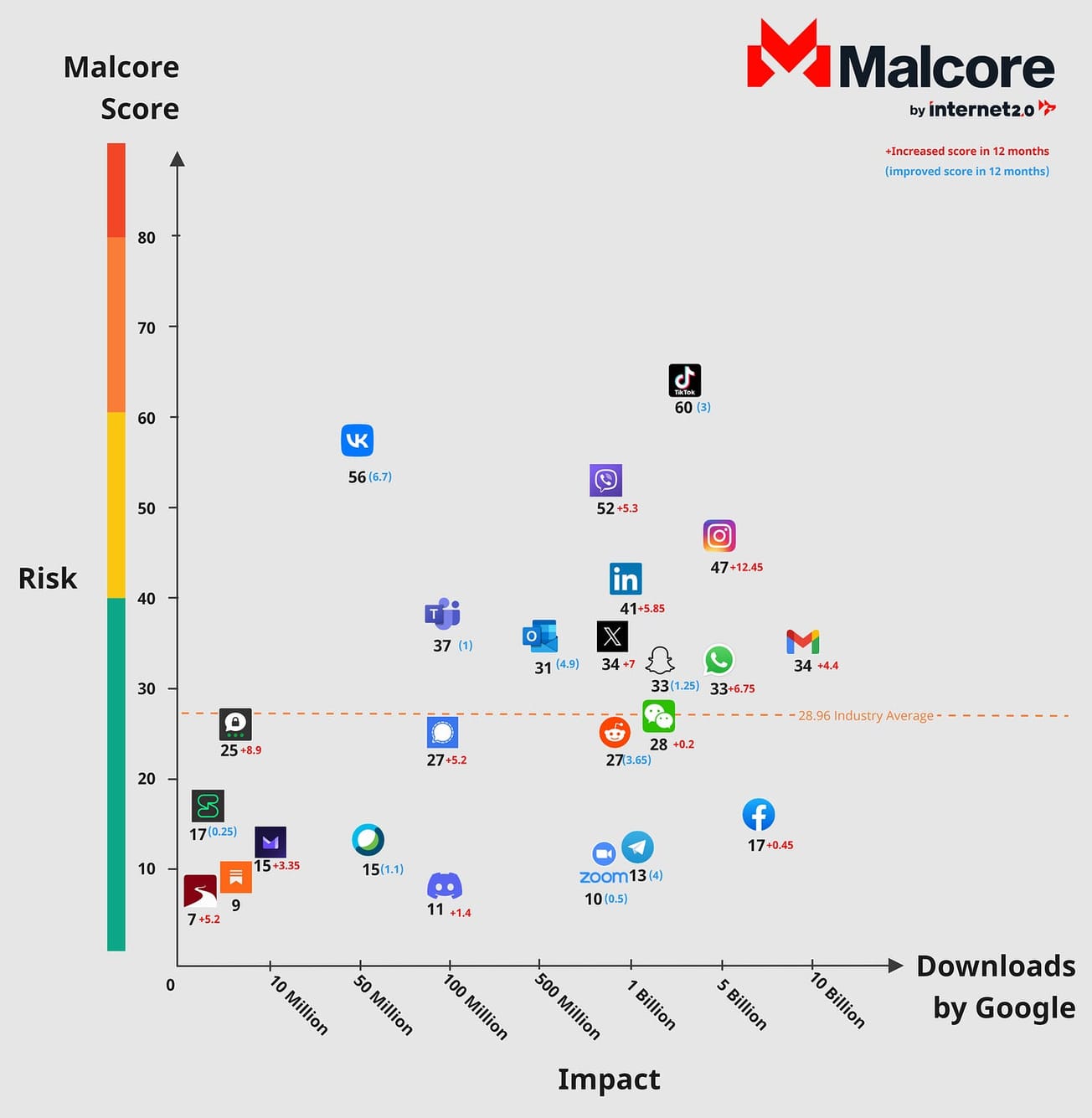
Published benchmarks, such as the 2024 Social Media and Communication Apps report, list apps in ascending order so readers can see which titles recorded the fewest detected signals in that edition.
What typically raises a score
Three signal groups account for most movement between apps:
- Android permissions that allow access to contacts, location, camera, microphone, or storage
- Third-party SDKs for analytics, advertising, crash reporting, and social login
- Network and data practices such as hard-coded endpoints, certificate pinning bypasses, or broad file access patterns
A messaging app that requests few dangerous permissions and bundles a small SDK footprint will usually score lower than a social platform with wide device access and a large advertising stack.
How to compare apps using published reports
Start with the research archives on the Internet 2.0 homepage, then open the vertical report closest to your question. The Australian Banking Apps 2024 study applies the same scoring model to financial apps, while the social media edition covers communication titles.
Look at the raw score, the year-on-year change shown in parentheses, and the linked Malcore share page for each app. A single-point shift can reflect an SDK update, a permission change, or a new library version rather than a deliberate privacy improvement.
Limits of static analysis
Malcore scores come from automated static review, not manual source inspection or runtime behavior testing. They are a fast screening tool, not a substitute for a full security assessment. A low score does not guarantee an app is safe, and a high score does not prove malicious intent.
For deeper work, pair published scores with the Malcore platform and targeted manual review when the stakes are high, such as regulated data or government devices.
Next steps
If you are new to Malcore scoring, read one vertical report end to end, then open two Malcore share links for apps you already use. Note which permissions and SDKs appear in each report before drawing conclusions. That habit makes the numbers far easier to interpret in future editions.